
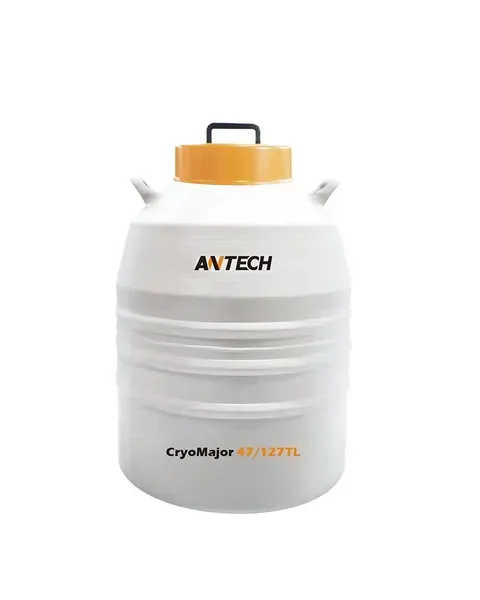
A Dewar is a vacuum-insulated vessel for cryogenic liquids such as liquid nitrogen, which boils at approximately −196 °C at atmospheric pressure. Depending on its design, a vessel may hold nitrogen, biological samples or both. Choosing one involves more than litres: consider its intended use, neck opening, sample storage system and evaporation rate.
Quick comparison: CryoMajor 2/35 · CryoMajor 10/50 · CryoMajor 35/125.
For a quotation, specify the capacity, sample format and required configuration. Request a quotation.
What is a Dewar used for?
The double-wall construction and vacuum insulation reduce heat transfer. Dewars are used in laboratories, biobanks, medicine and veterinary work for suitable sample storage protocols, and for holding or supplying liquid nitrogen. The vessel, sample containers and storage phase must be compatible with the intended application.
Sample storage, transport and nitrogen supply
- Sample storage: vessels with canisters or racks for organised cryogenic storage. See liquid nitrogen Dewars and sample-storage Dewars with racks.
- Transport: vessels specifically designed for moving nitrogen or samples. Check the permitted contents, orientation and transport conditions. See transport Dewars.
- Nitrogen supply: larger vessels used to maintain a working supply. See liquid nitrogen supply vessels.
These roles are not interchangeable by default. Use the manufacturer's stated applications to decide whether a particular model is suitable for storage, transport or both.
Canisters or racks?
- Canisters: commonly used for compatible straws, ampoules and other sample formats, depending on the vessel and accessories.
- Racks with cryoboxes: useful for organised collections and sample retrieval; check the rack dimensions, box format and required neck opening.
Capacity and neck opening
Liquid nitrogen capacity and sample capacity are different specifications. Check both, together with the exact canister or rack configuration. A narrower neck can reduce heat ingress; a wider neck improves access for larger storage systems. Compare the manufacturer's evaporation and holding-time data rather than relying on neck size alone.
CryoMajor model comparison
Compare catalogue size and neck opening. The links in the price column lead to product pages with current pricing, configuration and specifications.
| Model | Catalogue size, L | Neck opening, mm | Price |
|---|---|---|---|
| CryoMajor 2/35 | 2 | 35 | Current price |
| CryoMajor 3/50 | 3 | 50 | Current price |
| CryoMajor 6/50 | 6 | 50 | Current price |
| CryoMajor 10/50 | 10 | 50 | Current price |
| CryoMajor 10/80 | 10 | 80 | Current price |
| CryoMajor 13/50 | 13 | 50 | Current price |
| CryoMajor 15/50 | 15 | 50 | Current price |
| CryoMajor 20/50 | 20 | 50 | Current price |
| CryoMajor 25/50 | 25 | 50 | Current price |
| CryoMajor 30/50 | 30 | 50 | Current price |
| CryoMajor 30/80 | 30 | 80 | Current price |
| CryoMajor 35/50 | 35 | 50 | Current price |
| CryoMajor 35/80 | 35 | 80 | Current price |
| CryoMajor 35/125 | 35 | 125 | Current price |
| CryoMajor 50B/50 | 50 | 50 | Current price |
| CryoMajor 30/125 | 30 | 125 | Current price |
| CryoMajor 35/125TL | 35 | 125 | Current price |
| CryoMajor 47/127 | 47 | 127 | Current price |
| CryoMajor 47/127TL | 47 | 127 | Current price |
Browse by application: rack storage · temperature monitoring · cattle artificial insemination · transport Dewars · dry shippers · cryogenic sample storage systems · accessories.
Evaporation and holding time
Liquid nitrogen gradually evaporates even in a well-insulated vessel. Compare the specified static evaporation rate in litres per day and static holding time in days. These figures are measured under stated test conditions; opening frequency, handling, ambient conditions and the working load can reduce practical holding time. A static rating is not a guaranteed safe refill interval for valuable samples.
Liquid nitrogen safety
- Use only appropriate cryogenic vessels and follow the manufacturer's instructions and your facility's risk assessment.
- Provide adequate ventilation: released nitrogen can displace oxygen and create an asphyxiation hazard.
- Wear the specified cryogenic gloves, eye protection and protective clothing; use a face shield where splashing may occur.
- Never seal a vented Dewar airtight or obstruct its venting or pressure-relief arrangements.
- Use equipment approved for the intended transport conditions. Do not assume that a storage vessel is suitable for shipment.
Selection checklist
- Task: sample storage, transport or nitrogen supply.
- Capacity: nitrogen volume and sample capacity with the intended accessories.
- Neck opening: compatible with canisters, racks and handling needs.
- Evaporation and holding time: under documented conditions, with a practical refill and monitoring plan.
- Configuration: canisters, racks, cryoboxes, lid and security options.
- Weight and dimensions: including the filled vessel where relevant.
Frequently asked questions
How does a transport Dewar differ from a storage model? Its construction and permitted use are specified for a transport task. Check the exact model rather than assuming that all transport vessels or all stationary vessels have the same capabilities.
How long will the nitrogen last without refilling? Refer to the model's static rating and test conditions, then establish a suitable working refill interval for your actual use.
Should I choose canisters or racks? Match the system to the sample format, inventory method and retrieval needs.
How can several workstations be supplied? Compare suitable nitrogen supply vessels. Separately, some storage protocols use −150 °C cryogenic freezers; these are not interchangeable with a nitrogen supply vessel.
Need help selecting a Dewar?
Tell us your application, sample format, required capacity and handling conditions. We can help compare vessels, neck sizes and accessories for delivery across Ukraine. Contact us.
Safety reference: Cornell CHESS liquid nitrogen safety guidance. This overview does not replace training, the vessel manual or applicable local requirements.