
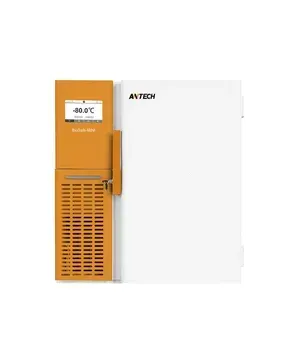
Ultra-low temperature freezers, also called ULT freezers or −80 °C freezers, support controlled storage of temperature-sensitive biological samples. Many models have a lower operating limit of −86 °C. Choose the freezer against the sample protocol, required working temperature, usable capacity, monitoring system and emergency response plan.
Browse our −86 °C ultra-low temperature freezers.
−80 °C or −86 °C: what is the difference?
“−80 °C freezer” often refers to the working setpoint, while −86 °C describes the lower operating limit of a particular model. These terms commonly refer to the same equipment class. Check the full specified range rather than assuming that every ULT model supports identical settings.
The storage protocol and equipment documentation determine the correct operating point. A lower temperature should not be selected simply as an extra margin: it can increase energy consumption and room heat load. If the method permits a higher temperature, compare the available −60 and −86 °C freezer classes.
Applications in laboratories and biobanks
ULT equipment is used in molecular biology, clinical research, pharmaceutical laboratories and biobanks. Depending on the validated method, stored materials may include nucleic acids, proteins, enzymes, serum, plasma, tissues, microbial stocks and selected biological products.
A general sample name does not define its storage temperature or shelf life. Consult the material documentation and the institution's SOP. Some applications require other freezer classes or cryogenic storage. Our medical freezer selection guide compares the main choices.
Calculate capacity in boxes and racks
Nominal litres do not tell you how many samples will fit. Check the exact vial, box and rack dimensions, shelf configuration and internal compartments. Include future growth, retrieval space and the manufacturer's loading restrictions. An organised inventory reduces the time spent searching with the door open.
For critical collections, plan backup capacity, a transfer route, independent monitoring and the people responsible for responding to alerts.
Upright, chest or compact freezer?
- Upright: convenient access to shelves, internal doors and racks, with a relatively small floor footprint.
- Chest: top access can reduce cold-air loss during brief openings, but requires more floor space and careful sample organisation.
- Compact: useful for a small collection, a dedicated workflow or local backup, provided the required performance and capacity are verified.
Cooling system and performance
ULT freezers use different refrigeration architectures, including cascade and other designs. Compressor count alone does not establish reliability. Compare temperature stability and uniformity, initial pull-down, recovery after access, warm-up during a power interruption, refrigerant, ambient limits and service support.
Performance figures are meaningful only with their test conditions. Compare models at the same setpoint and understand whether results refer to an empty or loaded cabinet.
Monitoring, alarms and emergency cooling
Check audible and visual alarms for high temperature, door opening, sensor faults and power failure. Verify which functions are included and which require an option. Suitable temperature data loggers and remote notifications support documented control and timely response.
CO₂ or liquid-nitrogen backup cooling is available only on compatible models. Its suitability depends on the sample requirements, allowed excursion time and the facility's backup arrangements. Gas supply, ventilation and installation must follow the equipment instructions. Backup cooling does not replace a written response plan.
Energy consumption and installation
Check the stated electrical supply, room temperature range, ventilation clearances and heat rejection. Confirm access through doors and lifts, floor loading and the proposed backup power source. Frequent or prolonged openings affect the refrigeration load.
Compare energy figures under equivalent conditions and include installation, monitoring, racks, maintenance and service in the total configuration.
ULT freezer purchasing checklist
- Document the required temperature and allowed deviations.
- Calculate actual sample capacity with the selected racks and boxes.
- Choose an upright, chest or compact layout.
- Review uniformity, stability, recovery and warm-up data.
- Specify alarms, records and remote monitoring.
- Define backup storage, cooling and sample transfer arrangements.
- Check installation conditions, warranty and local service.
- Agree any qualification and temperature mapping needed after installation.
Frequently asked questions
Can a standard freezer replace a ULT freezer?
Only equipment rated and verified for the required temperature and application should be used. A conventional freezer does not provide a −80 °C storage environment.
Does −86 °C always provide better storage?
No. Use the material's approved protocol. A lower setpoint is not a substitute for evidence about stability or storage duration.
What determines the price?
Capacity, construction, performance, monitoring, internal fittings, backup options, delivery and commissioning all affect the quotation. Compare complete configurations for the same task.
Selection and supply in Ukraine
OSELY can help select a ULT freezer by working temperature, sample format, capacity and monitoring requirements. Request a consultation to discuss delivery, commissioning, qualification and service.
Related equipment: −86 °C freezers · −150 °C cryogenic freezers.