
OSELYA YUT LLC provides temperature validation and temperature mapping for refrigeration equipment throughout Ukraine. Before work begins, we agree on the object, study objective, operating range, duration, and acceptance criteria. The client receives a protocol, measurement data, graphs, conclusions, and practical recommendations.
Need a preliminary quote? Send the equipment model, temperature range, city, and preferred timing to info@oselyayut.com.ua or call +38 (067) 821 46 96.
Applicable equipment and areas
- medical, pharmaceutical, and laboratory refrigerators;
- freezers for plasma, biological material, and laboratory samples;
- thermal containers and other cold-chain equipment;
- cold rooms and storage areas, subject to technical review.
When validation or revalidation may be needed
- when new equipment is commissioned;
- after relocation, major repair, or a configuration change;
- to investigate temperature deviations;
- during periodic assessment based on the internal procedure and risk assessment;
- before an audit or tender when the client requirements call for a relevant report.
Validation of refrigerators for vaccines and medicines
For equipment maintaining +2…+8 °C, temperature mapping helps identify the warmest and coldest locations, assess uniformity and stability, and select a representative monitoring-sensor position. Door-opening or power-failure recovery tests are performed only when included in the agreed protocol.
View equipment: +2…+8 °C medical refrigerators for vaccines.
Validation, qualification, and calibration
Calibration confirms the characteristics of an individual measuring instrument. Validation and temperature mapping assess the entire refrigerator, freezer, or storage area under agreed conditions. Depending on the objective, qualification may include IQ, OQ, and PQ stages.
| Stage | What is assessed |
|---|---|
| IQ | installation, completeness, and equipment documentation; |
| OQ | functions and temperature ranges under agreed conditions; |
| PQ | performance under actual use or loading conditions. |
Not every project requires all three stages. The scope is defined by the objective, documentation, and client requirements.
How the work is performed
- Input review. We confirm the model, volume, temperature range, operating conditions, and the client’s objective.
- Protocol. We agree on logger placement, recording interval, study duration, and evaluation criteria.
- Measurements. Temperature is recorded at the agreed control points under the approved operating conditions.
- Analysis. We assess stability, uniformity, minimum and maximum values, deviations, and risk areas.
- Report. We provide results, conclusions, and practical recommendations.
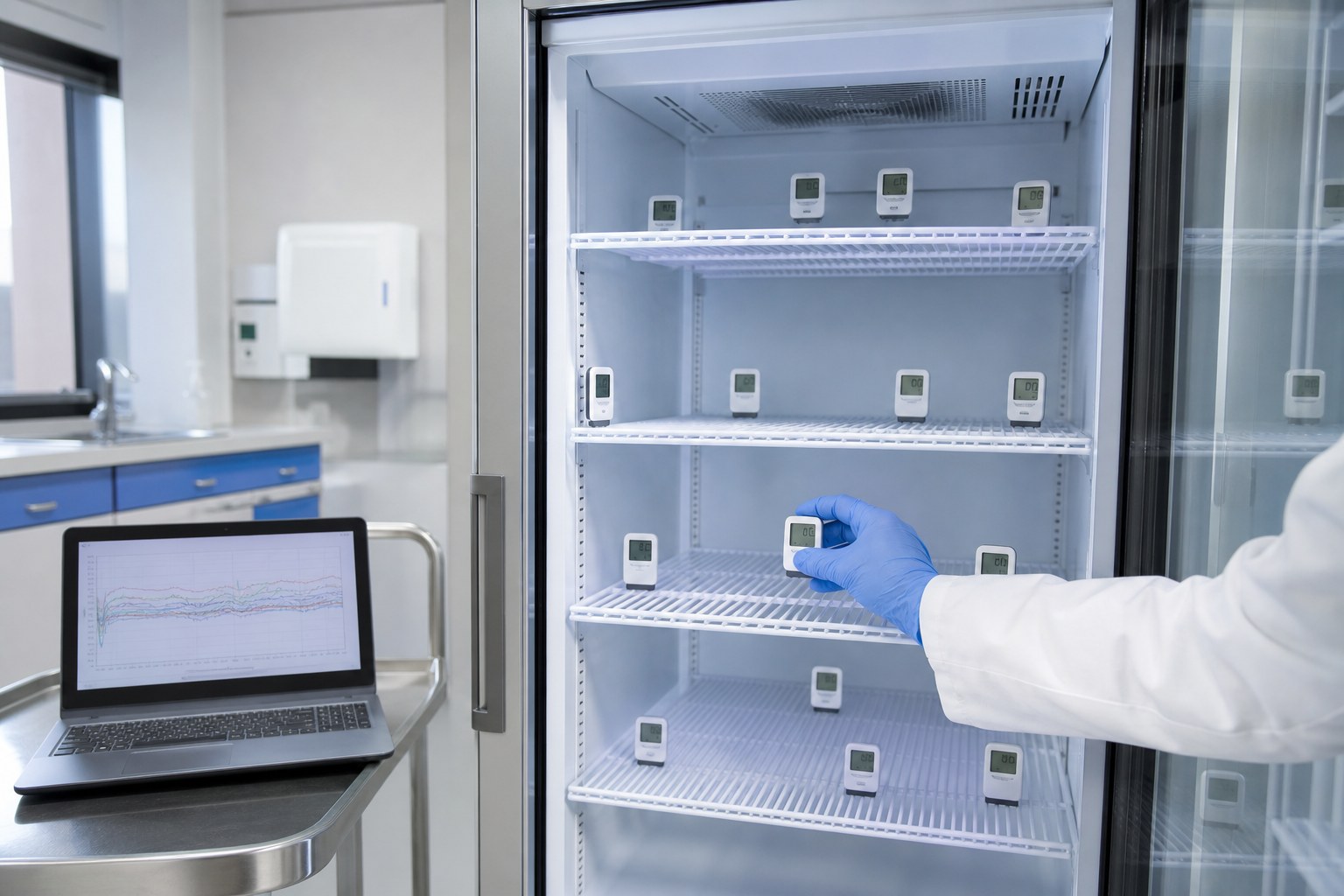
Placement of data loggers at the chamber control points during temperature mapping.
What the client receives
- an agreed study protocol;
- a temperature-logger placement diagram;
- data tables and temperature graphs;
- a list of recorded deviations;
- a final report with conclusions and recommendations;
- details of the measuring instruments and calibration documents within the agreed deliverable package.
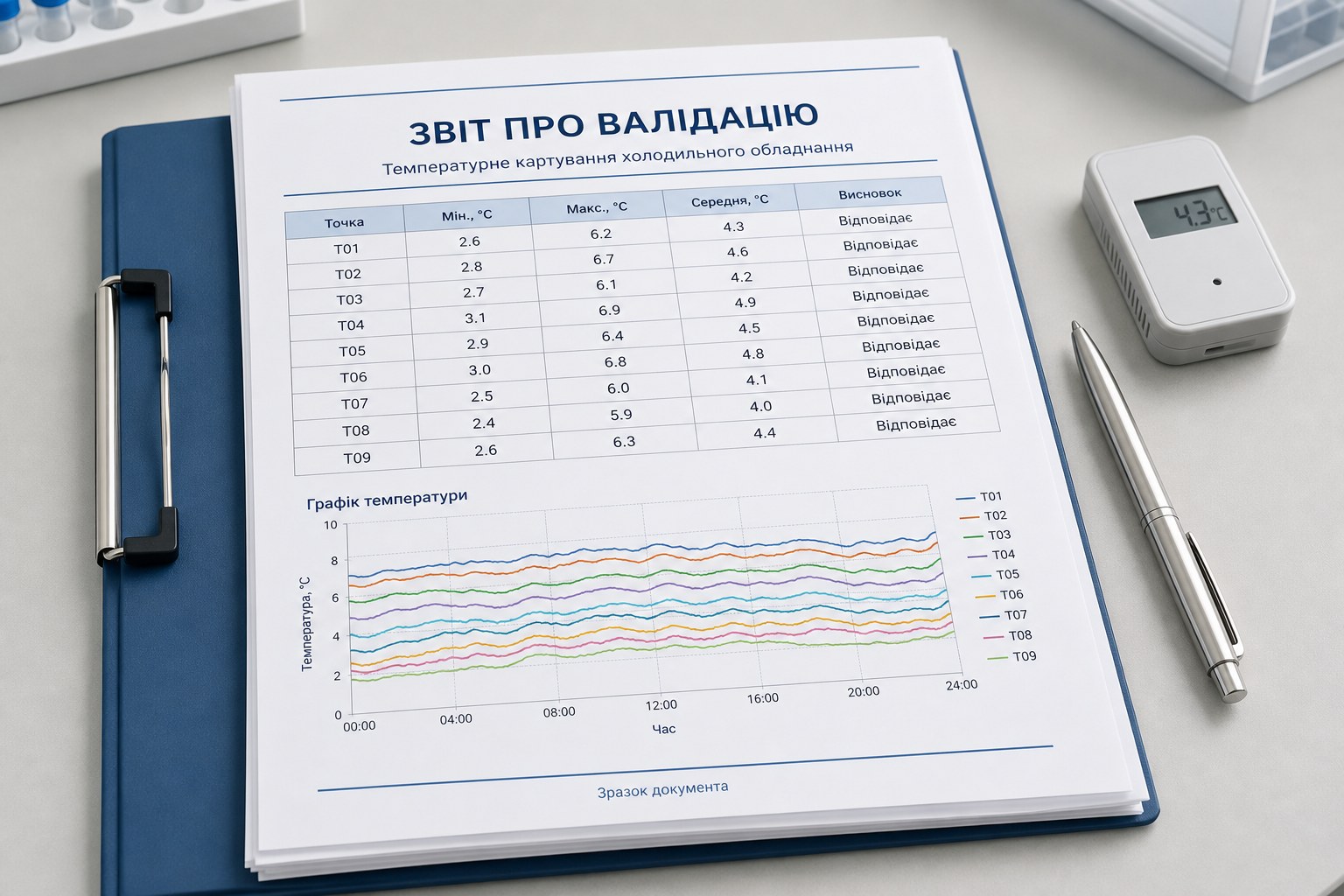
Illustrative document sample. The actual report contents depend on the agreed protocol.
Method and acceptance criteria
The method is defined for the specific object, taking into account its intended use, manufacturer documentation, the client’s procedures, and applicable regulatory requirements. Where relevant, we refer to WHO guidance on temperature mapping for cold-chain equipment and storage areas. The number of measurement points and study duration depend on geometry, volume, operating mode, and the validation objective; there is no universal setup for every object.
Timing and factors that affect the price
Measurements typically run for 24 to 72 hours. The final report delivery time and price depend on the object type and volume, temperature range, number of operating modes and additional tests, location, urgency, and the agreed deliverable package.
Important: the report records the results of a specific study under agreed conditions. It is not an accreditation certificate and does not by itself guarantee acceptance by a regulator, auditor, or tendering authority.
Frequently asked questions
How is validation different from calibration?
Calibration applies to a specific measuring instrument, while validation assesses the temperature conditions throughout the usable volume of the equipment or area.
Should the refrigerator be empty or loaded?
This depends on the objective and qualification stage. Testing may be performed unloaded or under actual-use conditions; the equipment state is agreed in the protocol before measurements begin.
How often is revalidation needed?
Frequency is determined by the internal procedure, risk assessment, manufacturer recommendations, and applicable requirements. Unscheduled assessment may be appropriate after repair, relocation, an operating-mode change, or a significant deviation.
What happens if a deviation is found?
The report records the results and provides recommendations. Repair, corrective work, and repeat testing are agreed separately.
How can I obtain a quote?
Provide the equipment model and volume, temperature range, city, loading conditions, required tests, and preferred timing.
Request a consultation
Email info@oselyayut.com.ua or call +38 (067) 821 46 96. We will confirm the inputs and propose a proportionate scope of work.
For more detail on preparation, criteria, and deliverables, read “Medical refrigerator validation: complete guide”.