





|
Quantity
|
Total
|
||
|
|
|||
|
|
|||
Medical Ventilators
Medical ventilators should be selected for the patient groups and care setting: intensive care, patient transport or neonatal respiratory support. Compare the exact model and configuration against the department’s requirements.
Specify the clinical setting
For intensive care, review supported patient groups, invasive and non-invasive modes, monitoring and required accessories. For transport, check approved operating conditions, mounting, power autonomy and gas supply. Neonatal applications require confirmation of the supported patient range, flow sensors and compatible interfaces.
Compare complete configurations
Ventilation modes, CO₂ or SpO₂ monitoring, batteries, trolley, humidifier and circuits may depend on the ordered configuration. Do not assume that every option is included or that a general model description covers every patient group.
Selection and supply
Send OSELY the intended setting, patient groups, required modes, gas sources, autonomy and accessories. We can prepare a comparison and quotation, with model-specific documentation, commissioning and service requirements.
What to compare before ordering
| Criterion | What to verify |
|---|---|
| Intended use | Workflow and functions defined by the institution’s responsible specialist |
| Compatibility | Existing equipment, accessories, consumables and interfaces |
| Placement | Dimensions, movement, connections and staff access |
| Procurement | Exact configuration, documentation, training and service terms |
Questions before selection and procurement
How should a technical specification be prepared?
Describe the workflow, required functions and compatibility with existing equipment. The institution’s responsible specialist defines clinical application requirements.
Why compare configurations rather than just base prices?
Quotations may differ in modules, accessories, consumables and connection work. Compare equivalent scopes of supply.
What should be checked before approving an order?
Model and version, intended-use documentation, included equipment, connections, service terms and commissioning arrangements.
What is needed to compare quotations?
A technical specification and an equivalent equipment list for each option. Specify quantity, installation or use location, compatible accessories and documentation requirements. This supports comparison of the complete cost of the required solution.
Configuration and documentation
Record the exact model, version, standard equipment and optional items in the quotation. Request the manual and specification with the conditions under which performance figures are determined. Agree procurement documentation, availability, delivery, warranty and service work for the specific supply.
Models in the catalogue
| Model | Configuration focus |
|---|---|
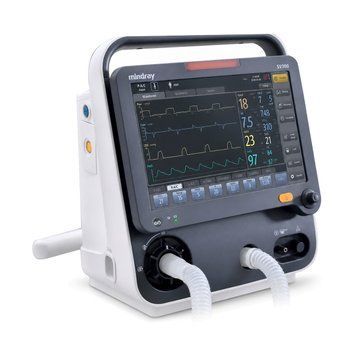
| Mindray SV300 ventilator | Mindray SV300 is a compact turbine ventilator for adult and pediatric intensive care. |
| HAMILTON-C1 ventilator | HAMILTON-C1 is a compact turbine ventilator for adult and pediatric intensive care and intrahospital transport. |
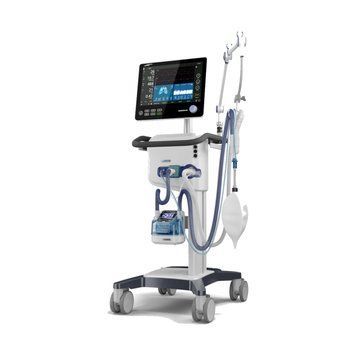
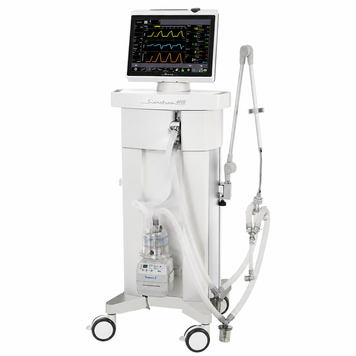
| HAMILTON-C6 ventilator | HAMILTON-C6 is an intensive care ventilator with a 17-inch touchscreen. |
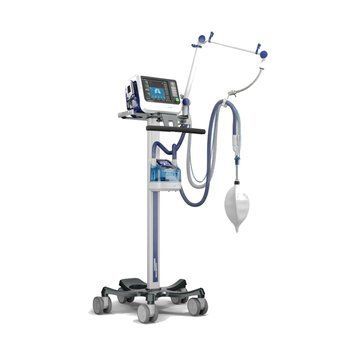
| SIARE FALCO 202 EVO transport ventilator | Configuration with HFNC, Vapour 2000, trolley, circuits, cannulas and filters. |
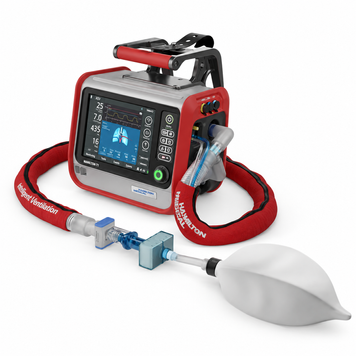
| HAMILTON-T1 transport ventilator | HAMILTON-T1 is a turbine transport ventilator for adult, pediatric and neonatal respiratory support. |
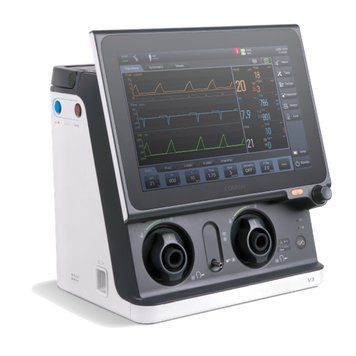
| Comen V3 ventilator | Comen V3 is a turbine ventilator for adult and pediatric intensive care. |
| Comen V3 Neo neonatal ventilator | Comen V3 Neo adds neonatal respiratory support to a platform for neonates, children and adults. |
| Comen NV8 neonatal non-invasive ventilator | Comen NV8 is a non-invasive ventilator for neonatal and pediatric respiratory support. |
| AEONMED Shangrila 510S transport ventilator | AEONMED Shangrila 510S is a compact transport ventilator with pneumatic drive and electronic control. |
| Prunus Boaray 5000D ventilator | Prunus Boaray 5000D is a stationary ventilator for intensive care with pneumatic drive and electronic control. |
| AEONMED VG70 ventilator | AEONMED VG70 is a turbine ventilator for intensive care. |
| SIARE ARIA 150 Turbine ventilator with capnography | Turbine ARIA 150, Masimo Mainstream CO₂, HL7 and VAPOUR 2. |
| SIARE SIARETRON 4000 ICU Turbine ventilator | Turbine, 15-inch display, trolley, battery and 10+10 circuits; humidifier quoted separately. |
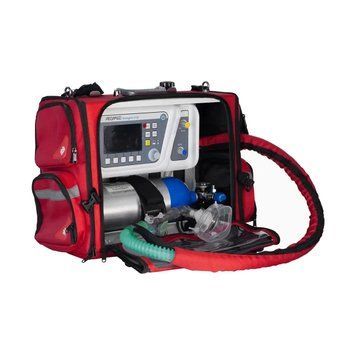
| SIARE FALCO 202 EVO ventilator — ambulance kit | Transport kit: empty 2 L cylinder, Pin Index regulator, 2 × 10G plates, external battery and 3 adult circuits. |
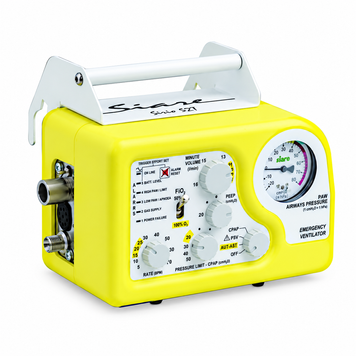
| SIARE SIRIO S2/T transport ventilator with support | Portable ventilator with PEEP, support, bag, strap and 10G plate; cylinder agreed separately. |
Features and accessories depend on the exact configuration. Compare complete supply lists as well as model names.