






|
Quantity
|
Total
|
||
|
|
|||
|
|
|||
Temperature Data Loggers for Cold Chain Monitoring
Start with the permitted temperature range, required accuracy, sensor location, recording interval, alarm limits and report format. An external probe is useful when the sensor must remain inside a chamber or container while the logger body stays outside.
Purpose and features
Temperature data loggers for vaccines, medicines, reagents and laboratory samples help document storage and transport conditions. The category includes three reusable models: the compact TempU04 USB logger, the TempU07 L100 with an external PT100 probe and the WF501B Wi-Fi temperature and humidity logger.
Three models for different monitoring tasks
TZONE TempU04
Range −30 to +60 °C, accuracy ±0.5 °C from −20 to +40 °C and memory for 32,000 records. PDF and CSV reports via USB; IP65 enclosure.
TempU07 L100
External PT100 probe, range −100 to +100 °C and memory for 34,560 measurements. PDF/CSV via USB, magnetic mounting and IP65 enclosure.
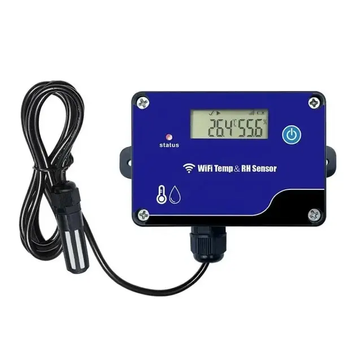
Temp WF501B Wi-Fi
Measures −40 to +125 °C and 0–90% RH. Wi-Fi connectivity, memory for 20,000 measurements, PDF reports and cloud storage; IP54 enclosure.
Compare the available data loggers
| Model | Measured values | Range | Memory | Interface and report | Typical use |
|---|---|---|---|---|---|
| TZONE TempU04 | Temperature | −30 to +60 °C | 32,000 | USB 2.0; PDF and CSV | Compact logger for routes and controlled areas |
| TempU07 L100 | Temperature, external PT100 probe | −100 to +100 °C | 34,560 | USB 2.0; PDF and CSV | Chambers and containers requiring a remote probe |
| Temp WF501B Wi-Fi | Temperature and relative humidity | −40 to +125 °C; 0–90% RH | 20,000 | Wi-Fi; PDF and cloud storage | Remote monitoring where a stable Wi-Fi network is available |
How to select a logger for vaccines and medicines
USB models support autonomous recording followed by report download. Wi-Fi is suitable for remote observation when a stable network is available. Memory, alarms or a PDF report do not by themselves confirm compliance with a particular procedure: calibration intervals, record retention and excursion limits must be defined by the organisation's approved protocol.
Questions before selection and procurement
Which matters more: volume or temperature holding time?
Assess both together with the load and route. A stated holding time is meaningful only with its test conditions and system preparation method.
How should two transport configurations be compared?
Use equivalent loads, ambient conditions, preparation and test end criteria. Differences in these conditions can change the comparison.
What logger information is required?
Range, accuracy, sensor location, recording interval and report retrieval method. Define load acceptance criteria in advance.
What is needed to compare quotations?
A technical specification and an equivalent equipment list for each option. Specify quantity, installation or use location, compatible accessories and documentation requirements. This supports comparison of the complete cost of the required solution.
Configuration and documentation
Record the exact model, version, standard equipment and optional items in the quotation. Request the manual and specification with the conditions under which performance figures are determined. Agree procurement documentation, availability, delivery, warranty and service work for the specific supply.
Models in the catalogue
Open the model page to check specifications, configuration and the current offer:
Related categories and useful information
- Medical refrigeration equipment
- Refrigerators (medical, pharmaceutical, laboratory)
- Freezers (medical, laboratory)
- Modular cold and freezer rooms
- Explosion-proof refrigerators and freezers (ATEX)
- Transportation of vaccines and medicines
- Validation and temperature mapping
- Project support
- Technical service