


|
Quantity
|
Total
|
||
|
|
|||
|
|
|||
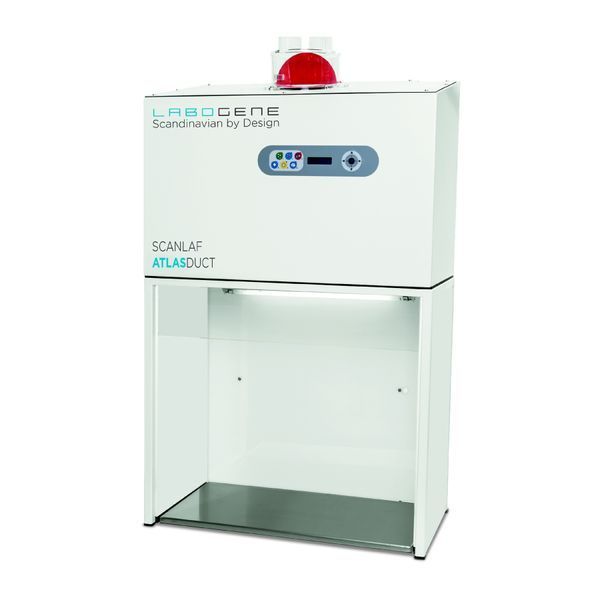
LaboGene ScanLaf Atlas Duct Compact Class I Safety Cabinet is a narrow benchtop cabinet for local operator and environmental protection when handling powders, aerosols and chemicals. The series occupies approximately 630 mm of bench width.
Important: this is a Class I cabinet and does not protect the product, because unfiltered room air enters the work zone. Sterile or contamination-sensitive samples require a suitable Class II cabinet.
Protection classClass I — operator and environmental protection; no product protection
Inflow velocity0.4–0.7 m/s
HEPA filter110 mm depth; 99.999% efficiency at 0.3 µm
Atlas Duct configuration
HEPA-filtered air is discharged through an external exhaust system. The internal fan maintains protection if external ventilation stops; the design includes an anti-blowback valve and signal PCB for ventilation interlocking.
Atlas Duct must always be engineered with the laboratory exhaust system. Air volume, connection, signals and the safe discharge point must be agreed before ordering.
Key features
- stable 0.4–0.7 m/s inflow through a fixed 400 mm opening;
- 99.999% HEPA efficiency at 0.3 µm;
- eye-level LCD, automatic start/stop, timer and lighting control;
- time and airflow alarms;
- front service access and a compact benchtop footprint.
Confirmed specifications
| Protection class | Class I — operator and environmental protection; no product protection |
|---|---|
| HEPA filter | 110 mm depth; 99.999% efficiency at 0.3 µm |
| Inflow velocity | 0.4–0.7 m/s |
| Work opening | Fixed 400 mm height |
| External dimensions | Approx. 627 × 340 × 1075 mm (W × D × H), based on the manufacturer drawing |
| Working area | Approx. 573 × 285 × 535 mm (W × D × H), based on the manufacturer drawing |
| Bench width occupied | Approx. 630 mm |
| Fan | Energy-efficient EC fan; current consumption below 0.2 A |
| Controls | LCD panel, automatic start/stop, time and lighting control, airflow alarms |
| Service access | Front access to filters, PCB, sensors and adjustments |
Options
PIR sensor, 700–1000 mm electrically adjustable stand, USB port, airflow sensors, pressostat and external ventilation signals. The final configuration is defined after assessing the process and substances.
Another model in this category: LaboGene ScanLaf Atlas Pro Compact Class I Safety Cabinet