


|
Quantity
|
Total
|
||
|
|
|||
|
|
|||
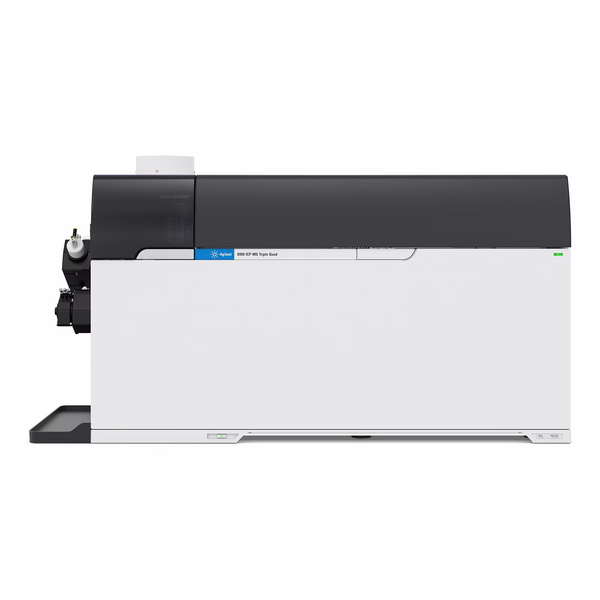
Agilent 8900 is a tandem ICP-MS/MS for multielement analysis with challenging spectral interferences. The first quadrupole selects ions before the reaction cell and the second analyzes the products. This controls reaction chemistry and extends analytical capability for elements such as Si, P and S.
MATRIX WITH UHMI≤25% TDSmethod and configuration dependent
TECHNIQUEICP-MS/MStandem mass spectrometry
CELL GAS CONTROL4control channels
Key benefits
- MS/MS controls which ions enter the reaction cell.
- Reaction gases resolve isobaric overlaps in suitable methods.
- Helium mode reduces common polyatomic interferences.
- Four gas-control channels support different cell modes.
- UHMI extends high-solids matrix capability.
- Precursor- and product-ion scans support reaction-chemistry research.
Technical specifications
| Model | Agilent 8900 |
|---|---|
| Method | ICP-MS / ICP-MS/MS |
| Architecture | Tandem, Triple Quadrupole |
| Collision mode | He |
| High-matrix introduction | UHMI |
| Total dissolved solids | Up to 25% with UHMI; validate the method for the matrix |
| Software | ICP-MS MassHunter |
| Reaction mode | MS/MS with reaction gases |
| Gas-control channels | 4 |
| Research modes | Precursor and product ion scans |
| Mobile interface | Optional ICP Go |
| Autosampler and dilution | Defined by the supply specification |
Applications and configuration
For elemental analysis of environmental, food, pharmaceutical and industrial samples after appropriate preparation. Agree sample introduction, cone materials, gases, cooling, exhaust, autosampler, dilution equipment, computer, licences and installation. The 25% TDS capability is not a universal guarantee for every matrix. Specialist configurations, chromatography coupling and additional packages require an explicit specification. Price on request.
Compare with: Shimadzu ICPMS-2030.